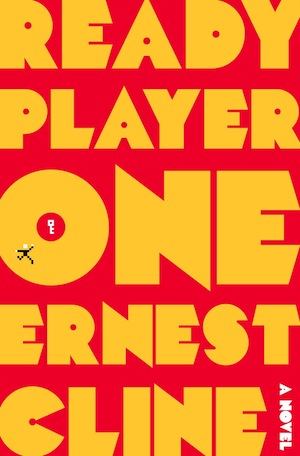
Ernest Cline’s Ready
Player One might well be one of the nerdiest books ever written. With space
battles, video games, and a plot that swerves between the real world and a
virtual counterpart, the book earns comparisons with geek-friendly fare like Ender’s Game and The Matrix. But what makes Ready
Player One so eminently nerdy is that unlike the fictional virtual worlds
it draws from, this book’s universe comes stocked with every bit of geek
culture imaginable. It’s not many a novel that sees R2-D2 as a DJ spinning New
Order discs.
The year is 2044. Environmental catastrophe impends, the
conglomerate IOI owns half the world, and poverty has grown so rampant that
most Americans live in skyscrapers built out of piled-up RVs. It’s a grim future but one with a catch. In
Cline’s retelling, in 2012, a Steve Jobs-like billionaire game designer created
a massive virtual reality game: the OASIS. For a scant fee, users could exchange
their unpleasant reality for a virtual haven, and so they did. The OASIS
quickly swelled up in size and function such that “the terms ‘the OASIS’ and
‘Internet’ gradually became synonymous.” By 2044, shopping, chatting,
and even federally approved schooling are some of OASIS’s more utilitarian
features, but for most users, the game functions more like World of Warcraft. Players send their avatars out into massive landscapes—some
original, some recreated fictional universes like Star Trek’s and Firefly’s—in
search of points and quests.

The most popular quest in OASIS is known as the Hunt. Hidden
throughout the game by deceased creator Jack Halliday are three keys whose
capture will unlock a grand prize: full control over OASIS and Halliday’s
estate. Five years of intense worldwide searching have turned up nothing, and
users are beginning to wonder if the contest is all a big hoax. That is, of
course, until an unlikely someone finds the first key.
Wade Watts is the prototypical star of nerd-beloved pop
culture: a young, orphaned male, friendless and penniless, Watts has little going
for him but for his good heart and clever mind. He’s an underdog of the classic
mold, one who, like Skywalker and Potter before him, finds himself swept up in sudden
fame, fortune, and danger. Cline tells Ready
Player One from Watts’s perspective, a narrative choice perhaps necessary to
describe all the leaping back and forth the book does from one world to another
but also one that provides access to Watts’s humorous internal monologue. Like many
raised on a heavy pop cultural diet, Watts communicates in speech peppered with
book quotes, movie quotes, and song lyrics. Dialogue between Watts and his
OASIS pals abounds with allusions obvious and subtle to things like Star Wars, internet memes, and, of
course, Monty Python and the Holy Grail.
If it seems improbable that the teenagers of 2044 should be
so well-acquainted with 80s pop culture, their cross-generational familiarity
is thanks to Halliday’s Hunt. A socially awkward computer nerd, Halliday felt
more comfortable with the movies, comics, and games of his youth than with
communicating with other human beings. For Halliday, the Hunt wasn’t just an
eccentric way of passing down his creation to a worthy successor, it was an
opportunity to rewrite the culture at large so that it shared his personal
obsessions. The only way to decipher Halliday’s clues is through an obsessive
knowledge of 80s pop culture and of Halliday’s enormous collected writings. There’s
a narcissistic component to his cultural revisionism, seeking as it does to
draw the whole world into one man’s passions, and Cline ties Halliday’s vanity
to the book’s thematic interest in the problems with nostalgia and escapism. Both
involve a retreat from reality into a world of personal fantasy, even and
especially when there are real problems that need to be fixed.

Still, Cline understands the appeal of escapism as well as
the distinctive pleasures contained within geek culture. Amassing mounds of
useless trivia as Watts and his friends do might seem dull and pointless to
outsiders, but Cline highlights the satisfaction and pride of possessing such
encyclopedic knowledge. And although the literary community has by and large turned
its nose up at video games, Ready Player
One is a gushing love letter to gaming, from its pixilated origins to its
increasingly immersive future. Although the book cautions about the dangers of getting
sucked into a virtual world at the cost of ignoring the real one, Ready Player One is ultimately
unabashedly pro-video games. I’ve never read a book that so perfectly captures
the exuberance of finally beating a difficult boss or of discovering a level’s
hidden secrets.
Like many plot-driven, first person narratives, Ready Player One occasionally suffers
from sounding like a laundry list of subject-verb sentences. (“First I did this.
Then I did this. Then I did this.”) Cline is no elegant stylist, but then
again, it’s not the prose that draws us into Ready Player One. It’s Cline’s sprawling, enthusiastic love for
geek culture. The absolute blast he has in melding together so many of his
interests is positively infectious. I couldn’t help but geek out myself watching
Cline unload every giant robot, warrior-mage, and space cowboy in his arsenal.

And what an exciting story he unloads them into. Ready Player One pumps us through its
pages with the ease of an addictive video game. It’s got everything you could want
from a mash note to geek culture: powerful villains, first romances, epic
quests--not to mention tons and tons of fighting. Whether it’s an arcade duel
or a shoot-off between spaceships, Ready
Player One rarely goes a chapter without some sort of battle. The siege of
a fortress toward the book’s end gathers together so many sci-fi and fantasy
characters in one giant clash, it will no doubt be a legal nightmare for the
inevitable film adaptation. Fun, smart, and fast-paced, Ready Player One is the best book featuring mecha-robot battles you’ll
read all year.