

I wrote a list of ingredients in the book, and warnings that [readers] shouldn't consume those ingredients. ...it honestly hadn't occurred to me that it was reverse psychology. I just thought that it was sort of an honest assessment making clear that if you were timid or easily disturbed, you could turn away.Rereading the first three Series of Unfortunate Events books for the first time in thirteen years, what surprised me most was indeed how honest Snicket's admonitions to the reader were. Despite its whimsy and wit, both of which are in plentiful supply, A Series of Unfortunate Events takes the exploitation of its child protagonists seriously and taps into some fairly dark moments in doing so.
The Series begins appropriately enough with The Bad Beginning. The three Baudelaire children stand on the shores of Briny Beach, and we are introduced to each of them in the first of many tripartite sequences, as actions/reactions of each Baudelaire child are described in turn. Violet is the eldest and a budding young inventor. Klaus, the middle child, is an avid reader. The infant Sunny is fond of biting things with her sharp little teeth. By design, the Baudelaires are relatively static characters. They arrive onstage mature, intelligent, and virtuous, and remain so throughout the rest of the series. They are mild-mannered lead characters, and what happens to them happens not because they heroically sought it out nor because they are being punished for wrongdoing. Their misfortune is accurately described by the series' title as simply "unfortunate events." Miserable things just happen to the Baudelaires, and it's not because they need to learn a lesson or grow up.

The first and really the unfortunate event of the series is the death of the Baudelaires' parents. Orphaned protagonists are not unusual in children's literature, but how many books start with or even include the parents' deaths? The insufferable Mr. Poe delivers the bad news, and Handler depicts the Baudelaires' reactions with quiet restraint. The children stand in silence, unable to process what they've been told. Klaus thinks of the family library consumed by flames and all the books he'll never be able to read. And then, holding one another's hands, the Baudelaire children set off with Mr. Poe, with nothing in the world but each other.
Well, almost nothing. What should have been their parents' greatest parting gift, the enormous family fortune, is actually the root cause of every bit of misery inflicted on the Baudelaire children from the moment of their orphanhood. It took me a stupidly long time to realize this, but the title of the series is actually a pun: A Series of Unfortunate Events. "Fortune" is embedded right into "Unfortunate," and it's the Baudelaires' fortune that's the source of all their troubles. The tragic irony of the series is that the Baudelaire children are more than responsible and capable enough of handling their inheritance money, but they are legally forbidden from doing so. As such, they are bounced about from incapable adult to incapable adult, all the while pursued by an evil and far-too-capable adult who wants the Baudelaires' money.
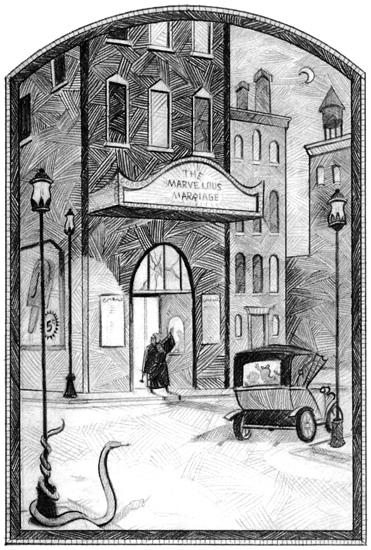
Before the Baudelaires spend twelve books being chased by Count Olaf, though, they are first served to him on a platter right at his own doorstep. The original and the worst of the Baudelaires' caretakers, Olaf provides the children with only a single room containing an uncomfortable bed; a cardboard box; and, in a quintessentially Snicket touch, a "small pile of rocks" to play with. Before long, the orphans are forced to participate in Count Olaf's play, The Marvelous Marriage, and must use their respective reading, inventing, and biting talents to thwart his plot to make Violet marry him for real. Although they succeed, Olaf escapes, and the Baudelaires are whisked off to their next home.
In The Reptile Room, herpetologist extraordinaire Uncle Monty is the kindest legal guardian the orphans are ever entrusted to, but before they can accompany him to Peru, a disguised Count Olaf kills Monty off. Again, the Baudelaires must use their individual skills to escape certain doom at Olaf's hands, which, again, they do. Finally, in The Wide Window, the Baudelaires move into a creaky shack overlooking a black, leech-filled lake. Their new caretaker is Aunt Josephine, a grammar obsessive and a paranoiac who would rather eat cold meals forever than risk turning on the stove ("It might burst into flames," she explains). Living with Aunt Josephine is far less fun than living with Uncle Monty, but it's certainly better than living with Count Olaf, who resurfaces in a fresh disguise as a one-legged sailor to claim the orphans' fortune. Klaus uses his penchant for reading to find the hidden meaning of an apparent suicide note left by Aunt Josephine. Violet puts her inventing skills to good use as they sail across the lake to rescue their guardian. And finally, Sunny takes one well-aimed bite at Olaf's peg leg to reveal that it's a fake at a critical moment. Olaf escapes as always, and the Baudelaires drive off to their next unfortunate event.
If there's one thing that grates upon rereading A Series of Unfortunate Events, it's the repetitiveness of the storyline. As I mentioned before, the Baudelaires are fairly static characters. This is interesting insofar as it relates to the gap between the way the adults think of the children and the way the children actually are, as well as the gap between the capability of the Baudelaires over every adult they meet, but from a narrative perspective, it leads to a lot of redundant storytelling. In each book, the Baudelaires are dished out an equal allotment of lines and a task whose solution lies within the skill set of each particular child. Handler somewhat manages to cover up the redundancy with entertainingly elaborate prose and Snicket's open dislike for the story he's telling. But even by the third book, I found myself a little tired of reading what was essentially the same plot pressed through new trappings. It would be less wearisome if each book moved not just in scenery but in theme and character, but the core message and characters remain the same throughout: reading and critical thinking are important, and the love of family can carry you through any situation, no matter how miserable. Trouble is, the Baudelaires knew this lesson from book one. They knew it as they held hands on the beach in chapter one of book one. So while Snicket's delivery of the Baudelaires' tale is amusingly written with its narratorial intrusions and fondness for SAT words, even a tale told well grows old when it's told over and over again.

Although I did begin to get a little weary by the third book and fear I may have nothing much to say when I write up books 4-6 next week, I did enjoy the first two books quite a bit. Although the Series shares much in common with other children's books--from orphaned heroes to dastardly villains, from children of unlikely talent to a general distrust of adults--the books are also weird and grim, their literary pleasure derived as much from style as from plot, in a way that's unique among kids' lit bestsellers. Unlike many other successful books for children, A Series of Unfortunate Events is also completely free of wizards, demigods, robots, vampires, and mutants. Which isn't to say the books are firmly planted in hard realism either. Indeed, the Series hovers high above the grounds of realism, stocking its geographically and chronologically hazy world with carnivorous leeches, villainous acting troupes, and an Incredibly Deadly Viper whose bite is harmless. Snicket's books are obviously not realistic enough to be classified as "real world" kids' books like The Wednesday Wars or Bud, Not Buddy, but they're also not fantastical enough to be classified as fantasy or science fiction. Instead, they dwell somewhere in between, in a vaguely Gothic middle ground between realism and fantasy. Brett Helquist's penciled illustrations and painted cover art solidify the quasi-fantastical Lemony Snicket look: long, spindly architecture and a fashion sense that's somewhere between the Victorian era and the 1920s. It's impossible to say how much of A Series of Unfortunate Events's success is attributable to Helquist's enticingly maudlin art, but his pen and brush work are a vital part of the Lemony Snicket universe.
So too is the Series' darkness, a term that demands immediate qualification. As much as the narrator warns of the misery and gloom contained within, A Series of Unfortunate Events is an innocuous and amusing reading experience, and the dire warnings are just part of the fun. Not a single one of the books ever approaches the gut-sinking despair of young adult novels dealing with weighty topics like sexual abuse and racism. If A Series of Unfortunate Events had actually been as off-putting and disturbing as it purports itself to be and still had the commercial success that it did, it would be one of the most interesting cultural phenomena of the past decade. But even though Lemony Snicket's books aren't really as miserable as Snicket bills them, they do still contain a not-inconsiderable amount of darkness, especially for a children's book series that sold as well as this one did.

Structurally, A Series of Unfortunate Events is atypically grim when it comes to juvenile fiction. Unlike Harry Potter or Artemis Fowl, the Baudelaires aren't usually doing fine with unfortunate things happening as deviations from their usual wellness. The status quo for the Baudelaires is misery, punctuated by brief moments of happiness that are shot down almost as soon as they arrive and that are undermined by the narrator as they're occurring. When the Baudelaires show up at their Uncle Monty's house, he serves them coconut cream cake, and together they plan an expedition to Peru. Throughout this episode, Snicket informs us that Uncle Monty is going to die not one, not two, but three times. The Baudelaires' moments of joy are never so much rises in fortune as tiny blips upward during a long, hard fall off Fortune Cliff.
The book's truly nasty streak, though, lies in its ever-present threat of violence. Most children's fiction imperils its young characters many times over, but there's a difference between children-in-peril played romantically and children-in-peril played realistically. The Baudelaires are ostensibly in greater danger when they're surrounded by leeches than when Olaf hits Klaus, but it's the latter scene of violence that's more disturbing and memorable. Although the series is chock full of hyperbolic, Indiana Jones-style danger, there are also moments of violence that feel more like genuine child abuse than adventure-story mayhem. Because A Series of Unfortunate Events is a book series for children, most of the time, realistic violence only peeks through in word rather than deed. In The Reptile Room, for example, Olaf takes out a large knife and threatens to cut off one of Sunny's toes. At other times, however, actual violence does occur. In the first book, Olaf rejects the meal he ordered the children to cook and when Klaus gets upset, Olaf strikes him across the face. The blow stings Klaus well into the next book, and the reader doesn't easily forget it either. The accumulation of moments like these, where Handler plays violence done to children realistically, gives the books a sense of genuine peril that's never quite obscured by all the word games, meta-commentary, and adventuring. Tellingly, the most iconic piece of artwork associated with A Series of Unfortunate Events is the cover of The Bad Beginning (posted above). On it, the children are small and diminutive in the background while Olaf towers over them in the foreground, looking almost twice their size. The threat of violence is never far from the Baudelaires, and it casts a long, inescapable shadow over everything they do.
Next week: I continue plowing through A Series of Unfortunate Events with Books 4-6! The Miserable Mill, The Austere Academy, and The Ersatz Elevator! Will I run out of things to talk about? I doubt it because I saved some stuff I could have said this time for a future entry!


No comments:
Post a Comment