

So... this project might have been a bad idea! Or at least choosing to reread A Series of Unfortunate Events might have been a bad idea! At any rate, it's six books in, and I'm getting pretty sick of this series already. Granted, I don't think these books were designed to have been consumed all in one go, but their constant repetitiveness certainly isn't helping either. The series was already starting to grate on me by the time I was skimming my way through the end of The Wide Window last week, but it's getting even worse now because I'm beginning to find the characters annoying too.
As I mentioned in my last post, the Baudelaire children are very mild-mannered. They are polite and demure, poised and virtuous; so much so that sometimes the books read a little like the child-saint hagiographies I had to read in elementary school. The Baudelaire saintliness is admirable in the way it provides young readers with good literary role models, but I am not a younger reader and these kids' passivity is starting to p. me o. (plus it's not like extreme passivity is that great in a role model either). As brash and dunderheaded as Harry Potter is, I'm starting to yearn for some of his devil-may-care attitude in these orphans because at least the boy wizard gets stuff done. In A Series of Unfortunate Events, the Baudelaires mostly wait around for miserable things to happen and then deal with the misery as it befalls them. Their default emotional state is a kind of glum resignation, when by all rights, it should be an almost insane rage. Time after time, the Baudelaires are ignored or cut off by some adult, and they sort of shake their heads sadly and decide it's no use to try arguing further. It's becoming unbearable for me that, even if it wouldn't do them any good, these kids don't scream and cry and plead with every fiber of their beings for someone to listen to them.
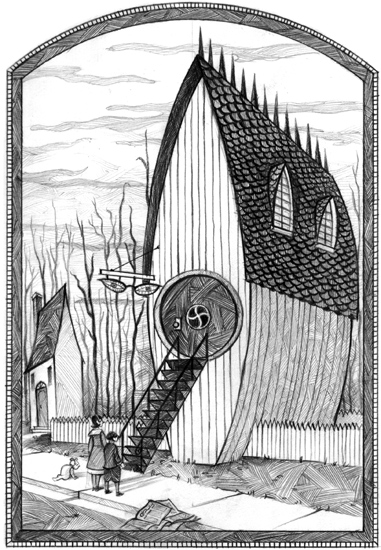
(Taking one look at their miserable new home overseen by their latest incompetent caretaker, Violet turned to her siblings and said, "Right. Enough of this. Klaus, what do you know about firearms?"
Klaus had read many books about firearms in the family library before it had burned down. "From the books I've read," he said, "I think I could explain how to construct a weapon from the items lying about this dilapidated house."
"Aboutime!" Sunny shrieked, which meant something like, "And I could put my tiny, sharp teeth to good use biting these bits of metal on the floor into bullets!"
Tying her hair up with a ribbon, Violet said, "Klaus and Sunny, with your respective researching and biting abilities, I think I could invent something to help us stop Count Olaf."
An hour later there was a knock at the door. Before the Baudelaires could even look up from their project, the door swung open to reveal a surprise most loathsome--a word here meaning "not very surprising at all because it was the horrible Count Olaf."
Wrapped from head to toe in bandages, Olaf appeared to be disguised as some sort of patient afflicted with a terrible skin disease. But even through the bandages, Olaf's nasty smile and gleaming eyes could be--
Violet shot Olaf in the face with a handgun.
"Violet!" Mr. Poe cried, approaching from the kitchen doorway. "You've just killed that poor, skin-diseased man!"
Not even bothering to respond, Klaus pulled Olaf's pant leg up to reveal the incriminating eye tattoo on Olaf's ankle. Violet dropped the homemade gun into Mr. Poe's arms with one hand and dropped the microphone she'd also invented onto the ground with the other hand. And walking side by side, the Baudelaires left behind the miserable house and their miserable lives as Sunny called back "FUUUU!" which meant something unfit to be printed here. The End.)
Parodies aside, I also feel that story-wise, things are similarly getting a little too unrealistic in this second installment of books, even within the heightened reality the Series has established. Gone more or less entirely are those dark moments of realistic violence that gave the series a sense of genuine danger. It's all derring-do and standard adventure-story peril now, or at least it is in Books 4-6. Perhaps because of the difficulty of significantly incorporating an infant into an adventure story, Sunny's storylines in particular tend to push things into a Roald Dahl level of fantasy that doesn't quite feel in keeping with the tone that's been established. In the climax of The Miserable Mill, for instance, Sunny uses her sharp teeth to engage in an actual sword fight with an adult woman. Not only did this stick out for me as unusually and disconcertingly fantastical for the Series, I also just found it difficult to imagine logistically (plus it hurt my teeth to think about, which, admittedly, might have been the intent).
On the bright (gloomy?) side, there are some signs in these books that Handler's getting a little restless too and that he's begun exploring ways to shake things up a bit. In The Miserable Mill, in which the Baudelaire children are shipped off to a lumber mill and forced to overcome Olaf's plot to hypnotize Klaus, Violet must research books in order to save her siblings while Klaus must learn to do some impromptu inventing. It's not a huge shake-up, but at least it indicates a willingness to change. In The Austere Academy, Handler reveals the first signs of a larger storyline at work in A Series of Unfortunate Events. Sent to live in a boarding school, the Baudelaires meet the Quagmire Triplets, also orphans and also future inheritors of a large fortune. Before the book's end, though, Olaf has kidnapped the Quagmires, but not before one of them yells out the notorious acronym "V.F.D." In The Ersatz Elevator, another major character comes into play for the first time in Esmé Squalor, a fashion obsessive and all-around miserable human being. Not much more is revealed in terms of what the grand plot of the series is, but this book at least makes clear that there is indeed a grand plot: the infamous V.F.D. is brought up again (although its meaning still remains unclear), and the Baudelaires discover a secret tunnel running under the city, one that leads up into where the Baudelaire home once stood.
Next week: A Series of Unfortunate Events: Books 7-9! Will I enjoy these next books more than I did 4-6? Let's hope so! It's much nicer to enjoy things than to not enjoy them!

Their repetitiveness is why I never revisited them after I finished the series, I knew I had grown out of it.
ReplyDelete