Showing posts with label movies. Show all posts

Tuesday, June 26, 2012

Brave


As the mixed reviews for Brave rolled in, I told myself and others, multiple times I think: "Well, I'm just going to go into it with lowered expectations and then maybe I'll like it more than I expected." As I sat in the theater yesterday waiting for Brave to begin, it occurred to me what a ridiculous thing that was to say. The first part is fine--you can certainly adjust your expectations about a movie so that when you see it, you don't end up feeling let down if it's not that good. But the second part is absurd. The quality of the movie itself exists independent of my expectations surrounding the movie. If I go in expecting total garbage and end up watching something that's only mediocre, I still just watched a mediocre movie. Even more problematic, when I say I'm lowering my expectations because I think it will make the movie better, I'm thus also raising them back up again at the same time. It's this weird, circular process to try to inject quality into a movie that simply isn't good.

Anyways--Brave! It was only okay!

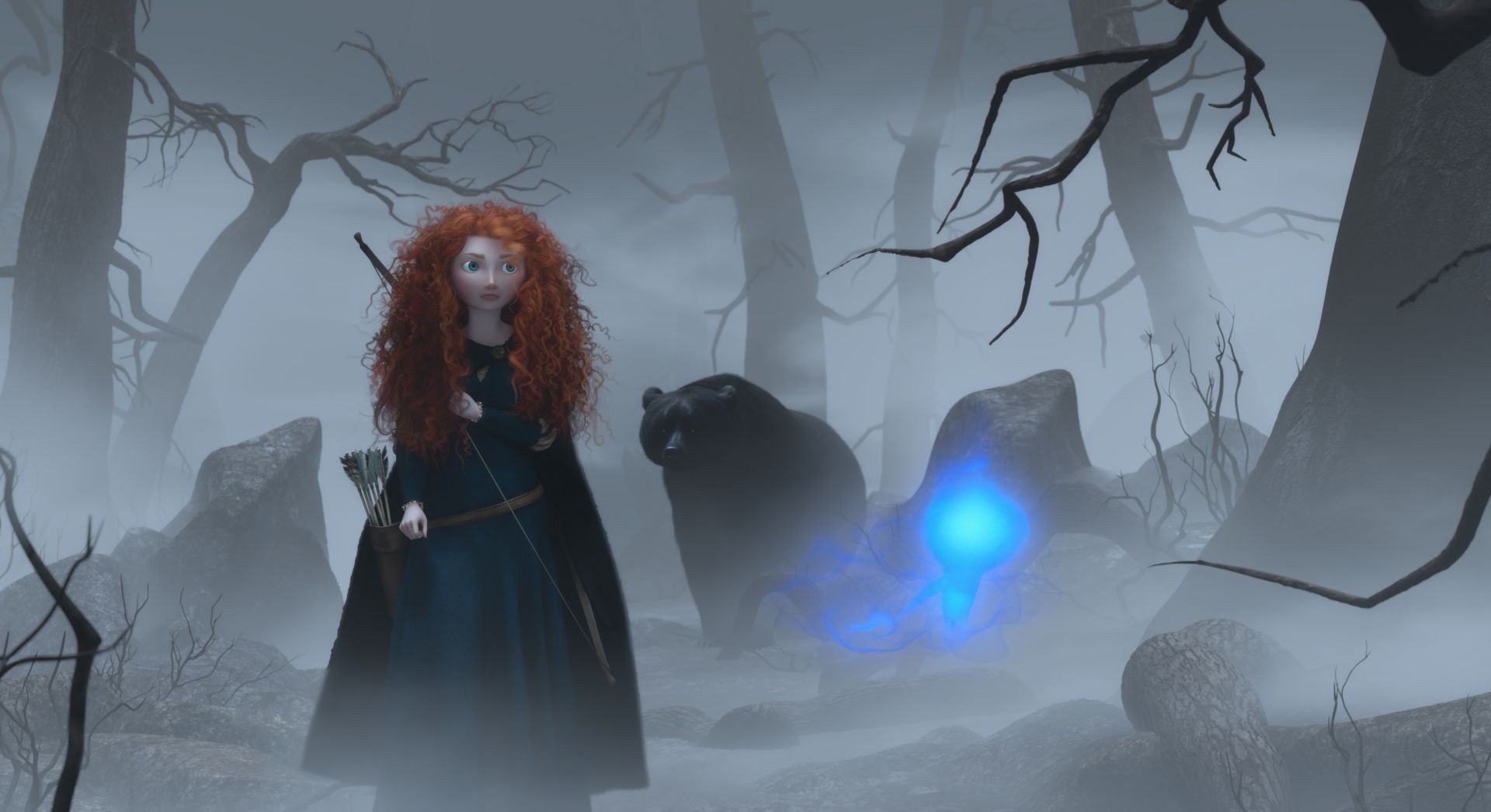
As the consensus between my siblings and I has confirmed as FACT so don't even argue, case closed, the first half of Brave is better than the second half. (Actually, the high point was probably the adorable, entrancing short in front of the movie, La Luna, but let's not be a jerk to Brave now.) Merida the young Scottish princess doesn't want to obey the strict rules she's expected to follow. Her mother the queen tries to corral her daughter into behaving like a proper lady of the court. She succeeds and the movie ends after ten minutes. (No.) It becomes pretty clear from the start that Brave is not going to tread any revolutionary territory, which is hard not to be disappointed about watching something from the same studio that made Monsters, Inc. and Wall-E. Still, the mother-daughter drama is effective and emotionally involving, and I did choke up a bit when (spoilers spoilers) Merida cut the tapestry and her mother threw her bow into the fire (the spoilers went away, come back, my child). And I suppose when I rewatch the film in the future, the end of that scene is probably when I'll get up to go read a book because it all gets increasingly disappointing from there on out.


Long story short (HUGE SPOILERS OH NO!), Merida accepts a spell from a witch and accidentally turns her mother into a bear. Merida sneaks her mother out of the castle, and there ensues some classic "I've been switched into a new body and don't know how to use it" humor. The queen tumbles down staircases, knocks over everything in her path, all the while insisting on wearing her tiny golden crown. It's a very funny scene, made even funnier by the Scottish clans' wild bear hunt across the castle. When the bear and the princess get outside the castle, though, the bear queen is forced to learn to fish, and at this point in the movie, an unpleasant wave of recognition swept over me. On the film's soundtrack, an acoustic guitar began to play, and it hit me: Oh no... I'm now watching Brother Bear.

I'm not a huge fan of people-turned-into-animals comedies in general, but I found it particularly grating in Brave because it undermines the mother-daughter relationship around which the entire movie is built. Watching a girl and her parent hash out their relationship problems is inherently interesting and potentially great drama, but watching a girl and her bear-mom maneuver their way around mom's being a bear is unoriginal and kind of boring. I've seen this shtick before in Brother Bear, The Shaggy Dog, and The Princess and the Frog (there are undoubtedly more too, but what am I going to do, sit here and try to remember movies where people turned into animals? Nope! #YOLO). More problematically, as a bear, the queen can't actually talk so every conversation between Merida and her mom in the second half of the movie involves heavy amounts of pantomime and bear grunts.


There's also something weird about Brave in how the whole movie seems to take place in Merida's backyard. Because the plot demands the characters to move from one set piece to another within a fairly short amount of time, by sheer spatial logic the entire story is forced to unfold within a two-mile radius of the castle. (I checked with measuring tape, hush.) There isn't necessarily anything wrong with that kind of enclosed setting in theory, but it does give the movie a bizarrely constrained feeling, as if there isn't anything going on beyond the very limited boundaries in which the story is taking place. It also explains why, for a movie stocked to the brim with sweeping landscape shots and horseback archery, Brave still feels very small in scale. I'm sure this also has partly to do with the intimate story between a mother and a daughter that the movie is telling, but it's also because that familial drama is situated almost entirely on the same chunk of real estate.

Brave wasn't a bad movie. It had some good jokes and the animation was of course spectacular, although I also feel like at this point that's almost a given. Like if I'm going to see an animated movie--particularly a Pixar movie--I just assume it's going to look fantastic and it always does such that great animation can no longer hide a mediocre story in the way that it might have been able to before studios were hiring out Roger Deakins for How to Train Your Animators to Produce Beautiful Lighting. And what's weird about Brave is that although the movie itself is rather predictable and dull, the characters are dynamic and memorable. Merida is a vastly more interesting protagonist than most main characters from kids' movies. The queen, too, is almost a main character in Brave, and to the best of my memory and a half-completed Google search, there just aren't a lot of kids' movies that showcase a girl protagonist and her relationship with her mother in the way that Brave does (or did until it turned into Mother Bear).

I liked the characters in Brave a lot. I just wish they were in a better movie.

Sunday, February 5, 2012

Chronicle


Most superhero movies do not begin with a scene of domestic violence. But then most superhero movies aren’t Chronicle.  The feature film debut of director Joshua Trank, Chronicle feels surprisingly original for a superhero movie and a found footage film. Despite its many influences—Akira, Cloverfield, and Kick-Ass among them—Chronicle manages to synthesize its inspirations into a film all its own: a superhero origin story built around an honest portrait of teenage angst.

Andrew Detmer (Dane DeHaan) has a miserable life. At home, his father is a violent drunk and his mother is bedridden. At school, he is bullied and unpopular, eating his lunches alone on the bleachers. Even Andrew’s cousin and only friend Matt (Alex Russell) doesn’t care for him. Andrew seems set for an ordinary if uncommonly depressing future. Until, of course, his life changes forever. At a party in an abandoned barn, Andrew, Matt, and popular kid Steve (Michael B. Jordan) stumble upon a deep hole in the forest out back. Contained within is a strange, glowing crystal. What this gem is or where it comes from remain a mystery but suffice it to say, after encountering the crystal, three weeks later the boys have superpowers.
Impervious to harm and able to move objects with their minds, the trio realize their bodies have changed and immediately use their powers to… screw around. They play pranks on bewildered locals, try to get girls, and goof off to entertain each other. Andrew and his friends have great power and no responsibility. They’re dumb teenagers who accept their awesome talents as another new feature of adolescence. None of the boys are emotionally or morally prepared for their powers, but none are less so than Andrew. Bitter and bullied all his life, he finally has the power to make every violent and angry thought in his head into reality. DeHaan plays Andrew with brooding self-enclosure and the slow, labored speech of someone who’d prefer not to be talking at all. Chronicle succeeds largely because of its intelligence in depicting Andrew and in making us feel sympathy for the neglected kid. One of the film’s best sequences belongs entirely to Andrew, as he undergoes a wardrobe change that’s paired marvelously with David Bowie’s “Ziggy Stardust.”
If Chronicle has a major weakness, it’s in Andrew’s cousin Matt. While Andrew plunges into darkness, Matt ascends to popularity. Matt’s journey revolves mostly around his romantic pursuit of Casey Letter (Ashley Hinshaw), a fellow classmate who films everything she does in a Manic Pixie Dream Girl quirk that exists to maintain Chronicle’s “found footage” conceit. Casey is not particularly interesting, or at least not enough so to make Matt’s courtship of her as involving as Andrew’s concurrent personal drama. As a result, the film feels a little lopsided, losing some of its steam every time we turn from Andrew and his problems to Matt’s making googly eyes at Casey.

Still, Chronicle makes more out of its scant budget than most superhero movies do with millions of dollars more. I must have seen by now dozens of films in which characters fly across the screen, and yet Chronicle somehow makes the sight thrilling and fresh. So too with the movie’s fight scenes, which have a physical reality and a sense of genuine peril usually lost in blockbusters’ billion-bullets-a-minute approach. It’s not just that Chronicle puts its special effects to good use—which it does—it’s that it situates its extraordinary events against a drab landscape. Stripped free of Hollywood gleam, the film’s cinematography captures the typically cloudy and rundown Seattle backdrop through a lens that by nature makes flying and telekinesis look all the more fantastic. It helps too that Chronicle’s leads couldn’t be more delighted with their powers, going positively giddy every time they discover some new use for them. 
Chronicle builds to an exciting if predictable climax that is hampered by the film’s refusal to abandon its found footage format. Cobbled together from security tapes, news recordings, and cell phone videos, Chronicle’s last act is pointlessly cluttered, and the film would have done better with a clean, straightforward finish. Nonetheless, the movie is a breath of fresh air in the wasteland of winter cinema releases. An unusually smart riff on the superhero mythos, it understands adolescent anguish as well as it does supermen in costumes. Although in Chronicle they don’t have costumes yet, they do have plenty of issues. 

Wednesday, February 1, 2012

Martha Marcy May Marlene


Martha Marcy May Marlene is a disturbing portrait of a fractured mind. After two years of living in a dangerous cult, Martha (Elizabeth Olsen) finally leaves and takes up residence at the vacation house of her estranged older sister Lucy (Sarah Paulson). But the transition from the cult’s eerie, self-contained world of alternating violence and tenderness to an ordinary life may be one Martha is no longer capable of making. The film operates from within Martha’s woozy perspective in which past and present are barely distinguishable. “Do you ever have that feeling where you can’t tell if something’s a memory or if it’s something you dreamed?” Martha asks her sister. It certainly doesn’t help that Lucy and her husband Ted are increasingly annoyed with their unexpected house guest. As tension mounts between the two sisters, it becomes apparent why the tight, familial bonds of a cult might have appealed to Martha in the first place.
Writer-director Sean Durkin represents Martha’s delirium with jarring crosscuts from Martha’s time with the cult to her new life at her sister’s. Each new scene puts us in Martha’s shoes as we grope uncertainly for visual markers of when and where we are in time and space. Unfortunately, as Martha quickly realizes, Lucy’s vacation house is eerily similar to the cult’s commune (and Ted too often sounds a little like the cult leader Patrick, played chillingly by John Hawkes). Instead of providing a mental anchor, the house’s garden and lake jolt Martha into memories of the cult. No matter where she is though, with the cult or with her sister, the tree-covered tops of the Catskill Mountains envelop Martha’s surroundings like Nature’s prison walls. Under the weight of her psychological burden, Martha sometimes bursts out in anger and sometimes just lies on the floor in shame. Her face, all pained smiles and watery eyes, looks ready to crack open at any moment.  Durkin ends the film on an ambiguous note, but regardless of how you interpret the final scene, it’s clear that it’s going to be a long time before Martha is free from her past.

Thursday, January 5, 2012

Nausicaä of the Valley of the Wind


Nausicaä is unusually quiet for a fantasy epic. Its world has been so ravaged by war and greed that life remains but in patches, both for nature and humans. Outside these pockets of life lie only sand and the blowing wind. When characters in Nausicaä are alone and speak their thoughts out loud, although they do this primarily as a function of the plot, it also makes an emotional sense. Their words seem like a way of filling up a dead and silent world.
Nausicaä’s world wasn’t always dying. We learn that long ago, plants began to spew toxic spores, slowly killing off humankind. Eventually, only a few communities of people were left, and they live in wary truce with both each other and the untamed jungles nearby. One such community resides in the Valley of the Wind, a Shire-like region tucked between two mountains by the sea. The people there live in isolation and peace, ruled over by their princess Nausicaä. Like many Miyazaki protagonists, Nausicaä is endlessly compassionate, engaging with the world around her in a state of joyful wonder. In two flourishes that would later be borrowed for Aang in Avatar: The Last Airbender, Nausicaä keeps an animal companion close by on her shoulder and travels across her world via a great, white glider. The sweeping shots of Nausicaä soaring across the landscape at once showcase the film’s breathtaking scenery and thematically reinforce Nausicaä’s ability to see the world from a grander, more wondrous perspective.
Unfortunately, the peace of Nausicaä’s homeland is soon threatened. A crashed airship in the Valley brings an invading army of Tolmekians, another group of surviving humans. The Tolmekians and their warrior princess Kushana plan to resurrect a Giant Warrior, one of seven ancient creatures that reigned fire down upon the earth and destroyed the ecosystem. With the Giant Warrior’s power, Kushana and the Tolmekians hope to destroy the toxic jungles and reclaim the earth for humanity. When the Tolmekians take Nausicaä prisoner, however, their plans begin to go awry. Soon Nausicaä finds herself in the middle of a bloody conflict between Tolmekians, the neighboring Pejites, her own people, and an increasingly enraged nature.  
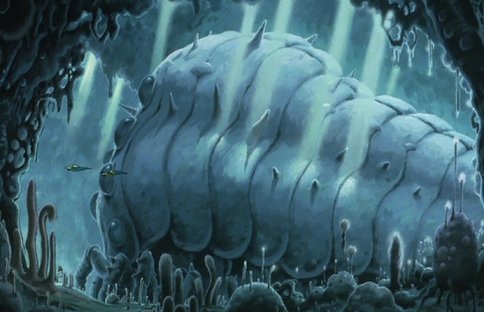
Although Nausicaä is ultimately an environmentalist film, its portrait of nature is surprisingly unromantic. The film depicts the natural world as an overgrown, poisonous jungle. Nature’s spokesperson is no gentle creature, nor even the white wolf of Princess Mononoke, but the Ohmu: giant insects whose blue eyes turn red with rage at the destruction humans wreak on their home.
Nature in Nausicaä is an enormous and potentially threatening force with which humans must reckon. Although Nausicaä demonstrates that empathy is the best response to this force, even as the model for human interaction with nature, Nausicaä is no Disney princess walking through the forest with woodland critters fluttering about her. The scene in which we meet Nausicaä establishes her relationship with the outside world. Carefully collecting spores from a plant, she happens upon the deserted shell of an Ohmu. Its crystalline form towers above her, and she approaches it with something like reverence. Covered in eyes and tentacles, Ohmu are slightly repulsive even as their intelligence and vastness grant them a kind of majesty. As the Ohmu exemplify, although insects are nature’s representatives in Nausicaä, it is humans who are insect-like in this film. We are tiny creatures approaching much larger life forms; the appropriate response can only be awe.
Despite the worshipful portrait of nature, Miyazaki is a fundamentally humanistic director, and in this film filled with numerous characters and dense plotting, it’s Miyazaki’s empathy that holds Nausicaä together. There’s no true villain in Nausicaä, and even dastardly characters like the Tolmekian ruler Kushana still emerge sympathetic. Although Kushana lies, murders, and cheats, she acts to save the human race from extinction, no matter how misguided or unethical her methods might be. Likewise, the violence other characters perpetrate on their fellow human beings and on the natural world stems not from any inherent malice but from the desire to protect their homes and families. Humanity, in Miyazaki’s portrayal, is essentially good but is divided hopelessly into warring factions that dangerously exploit the same earth they should be caring for. Humanity at its worst is symbolized by the Warrior Giants, themselves symbols of nuclear weaponry.  Soulless monsters that do nothing but destroy, the Giants lie at the root of mankind’s original quarrel with nature, and at the film’s end, Miyazaki suggests that only by abandoning such technology can humankind move forward, both toward unity with itself and with the earth.

Saturday, December 31, 2011

The Adventures of Tintin


From a kinetic title sequence to a final shot baiting for a sequel, The Adventures of Tintin never stops to take a breath. Racing from setpiece to setpiece, Tintin leaves not a single scene without at least a punch (if not a full-blown explosion). The wall-to-wall action should by rights be exhausting, but adventure is no foreign terrain for Steven Spielberg. Under his practiced direction, Tintin pulls us easily into its energetic pace, catching us up in an adventure story that feels familiar but is no less exciting in the telling.
Introduced via a gag that passes the baton from Tintin creator Hergé to Spielberg and co., Tintin (Jamie Bell) and his faithful dog Snowy find themselves caught up in a high-stakes chase around the globe after discovering a hidden secret in a model of the lost ship The Unicorn. Bell plays the famous comics creation with a bright, can-do verve, dashing without fear from rooftops and windows in certainty that good will win out.  Until it does, though, the adventuring pair is pursued by the sinister Ivan Sakharine (Daniel Craig, enjoying himself in an unusually villainous role), a hunt that quickly extends itself from land to sea, where Tintin meets the drunken but good-hearted Captain Haddock (Andy Serkis). Together, Tintin, Snowy, and Haddock struggle to unlock the mystery of The Unicorn before Sakharine can claim whatever treasure it holds or take them out in the process.
The Tintin comics always had a surreal humor to them, an element not lost in this adaptation. Every action scene pops along with a smoothness and grace that still make room for plenty of visual gags, a task aided by Spielberg’s new motion-capture toolset. Although sometimes pushing the film uncomfortably toward the Uncanny Valley (usually during close-ups that give us time to study the bizarre proportions of Tintin’s face), the motion capture is ultimately a boon to Spielberg’s work here, allowing him to create fantastic setpieces impossible in live action. One of the film’s most thrilling scenes is a sustained single-shot chase sequence through Morocco, and Tintin is at its best as it glides us through deserts, streets, and canals, gleefully following after the intrepid young journalist and his canine pal as they chase down an adventure.

Wednesday, June 30, 2010

A Plea Regarding Twilight Hating

So most of you will remember that about two years ago I penned a relatively lengthy parody of Stephanie Meyers' Twilight. The time during which I wrote this spoof was an interesting one for the Twilight series. Breaking Dawn had just been released, and the first trailers for the Twilight movie were trickling into theaters and the internet. More interesting, however, was that I think this time represented a sort of intermediary period for the Twilight books. A transition from one era to another (if you can call the space of a few months an "era"). I remember a time, before my Twilight spoof, I think it was in 2007, that the Twilight books were not just popular amongst a devoted few but were universally adored by all girls. I cannot think of a single girl I know who didn't read the Twilight books and who wasn't a fan of them. I think interestingly it's not that girls were unaware of Twilight's shortcomings, but rather that they were aware of them and chose to ignore them. I remember during this time being specifically asked by at least three different girls to not read the Twilight series, because they knew that if I did, I wouldn't be able to help but point out the numerous inconsistencies and general ridiculousness contained therein. So I stayed away from Twilight until I think around when Breaking Dawn came out--which I think was the turning point for most girls from loving Twilight to indifference towards it--before I finally read the book.

Well, as you probably know, I found it very amusing and sappy and so I wrote a parody of it, which was relatively popular on Facebook. Shortly after my spoof though, the release date of the
Twilight movie grew closer, and then Twilight really hit national attention. That's when it moved from being a girls-only property to being the subject of widespread derision. Once the movie came out, Twilight joined the ranks of those properties that are beloved by a small section of devotees but that are ridiculed and despised by the rest of the world (who feel very smug, cool, and rebellious in their hatred). Other such properties include, for instance, the Jonas Brothers, High School Musical, Hannah Montana, etc.
Now the thing you have to understand before I continue is that all of these properties do indeed suck. The Jonas Brothers are not mediocre musicians who are unjustly reviled, they are actually horrible musicians. But what I've grown so, so tired of is the endless, ubiquitous hatred of these properties, Twilight included. I think people imagine that they're being very counter-cultural and cool every time they proclaim their hatred for Twilight, but quite the opposite, I think they're just leeching off the "coolness" of putting down an easy target. And yeah, like I said before, Twilight does suck. I wrote a whole spoof revolving around its terribleness. But the Twilight books have been out for years, and the first movie came out in 2008. All the good jokes to be made about Twilight were made, and any other jokes about it at this point come across to me as only slightly more pathetic than the Twilight books and movies themselves. In fact, the only source that's really still generating amusing material from the Twilight series are the actual Twilight movies, which is why frankly, I have no complaints about them. They're hilarious films, and I've seen every one on its opening weekend.

And I can hear you now already saying, "Yeah, but I'm just so tired of
Twilight being everywhere, it's like you can't escape it and I just hate that." Yeah, well a huge part of that is your own damn fault. If you and every single stupid media outlet--from The Soup to SNL to virtually every website on the internet--would just stop talking about how bad Twilight is, it wouldn't be so ubiquitous anymore. Because frankly, the main reason Twilight gets thrust into my life isn't from the actual series itself but from people mocking it either on Facebook or television or the internet. And yeah, Twilight sucks, but stop leeching off the hatred for it in an attempt to be cool. There are no more jokes to be had from Twilight, save from the movies themselves. At this point, I would rather watch a Twilight movie than a Twilight parody, because the former is bound to be a lot more entertaining and amusing than the latter, albeit unintentionally.

If people really hated
Twilight as much as they purport to, I think that rather than dredging it up for a beating at every opportunity, they would just keep their mouths shut about it. But people aren't doing that and I think it's because they're really just hopping on the Twihate bandwagon. It's not that you can't or shouldn't ever diss it, I'm just sick of Twilight-hating as this incessant, ever-present sport. Hating Twilight is not cool and it's not counter-cultural, even though, yes, again, it does suck. I'm not saying you should like Twilight, and indeed you shouldn't because it's pretty awful. Just keep it down, mock it in moderation, and please don't think you're being cool for mocking it because everyone knows it's bad. To be cool in disliking something, amongst other things you have to actually be going against the status quo, which hating Twilight isn't. For God's sake, we still have two more years of Twilight movies down the road, so let's all just try to get through this unscathed.

Thursday, March 11, 2010

Alice in Wonderland

Once the shunned oddball stuck playing in his own corner of the Hollywood playground, Tim Burton has in the past few years become the idol of teenagers who fancy themselves artistic and dark. And while it's not hard to see how Burton's trademark macabre and misfit-as-the-hero movies appeal to those leaving childish things behind, Burton has drawn much criticism of late for stylistically repeating himself to the point, some would argue, of self-parody. Personally, while I recognize the validity of these criticisms and would like to see Burton expand as an artist (for which there is still plenty of time; Clint Eastwood is twice his age and is still cranking 'em out every year), to me Tim Burton is like a Hostess cupcake: not the greatest of its kind, not particularly good for you, but reliable in quality. You know what you're getting before you open the package. I think whether Burton works or not for any individual person depends on how much they like the Tim Burton aesthetic to begin with. And being a teenager who fancies himself artistic and dark, I'm usually on board for anything with Burton's name on it.

Although his films have always been associated with terms like "twisted" and "dark," Tim Burton's movies--Alice in Wonderland included--are only dark in design. The Burton canon may stylistically be full of looming shadows and twisting staircases, but the typical Burton tone is lighthearted and in fact often campy. There's nothing wrong with this style, but it is a mistake to think that Burton's films are dark in anything but atmosphere. And I think there was an incorrect assumption about Alice before the film came out that Tim Burton was "at last going to give the source material a fittingly spooky adaptation, unlike the watered down Disney version."The original Disney Alice in Wonderland, however, is actually much darker than Burton's film. Burton's Wonderland is clearly, and at one point literally, divided into "good" and "evil." The White Queen, the Mad Hatter, and the like are Alice's friends and protectors. Despite the movie's insistent (and annoying) winks that all the characters are "mad," Wonderland is less threatening than Narnia. Which is precisely what's wrong with Burton's Alice: it turns what could have been a surreal, dangerous story into a watered down The Lion, the Witch, and the Wardrobe. By contrast, the animated Alice in Wonderland is one of Disney's darkest movies. In that film, Wonderland is a wild and strange place, one that is hostile and uninterested in the plight of its child protagonist. At times, Wonderland threatens to swallow Alice up whole. Burton's film contains neither this sense of danger nor one of wonder.

Instead, the Tim Burton Wonderland is tame, dull, and rife with cliches. While the film is at first able to subdue its more trite elements with visual boldness and sharp CGI, the movie's awful last act is enough to push Alice from being a barely good film to being a disappointingly mediocre one. At one point in the film's conclusion, after an (anti-)climactic battle, Johnny Depp's Mad Hatter character begins to dance in celebration, and for one horrifying moment, it appears that the film is going to turn into Shrek. Fortunately, the scene ends before this can happen, but not before it tosses the audience's goodwill to the wind. The movie's final scene, in which Alice conveniently wraps up all the film's hanging dilemmas in one monologue, hammers the final nail into the film's coffin.

While Tim Burton's artistry is usually enough to carry even the director's weaker films, this one cannot be helped. I'd like to lay the blame on the hackneyed screenplay, but Burton is a good enough filmmaker that he should've known and corrected the script's weaker aspects. Unfortunately, Alice in Wonderland is nothing more than Lewis Carroll's classic novel churned through the Hollywood family film formula as presented through Tim Burton's typically morbid visuals. It is Burton's worst film since Planet of the Apes.

Sunday, February 21, 2010

Precious: Based on the Novel "Push" by Sapphire


I saw the film Precious: Based on the Novel "Push" by Sapphire under unusual circumstances. My school was hosting a screening of Precious with an inferior copy of the film: the aspect ratio had been pan and scanned, the image quality was blurred and indistinct, and the volume was left at an earshatteringly loud level throughout the whole screening. Bizarrely though, I think all these setbacks might have ultimately benefited the movie. In reviews of Precious, I've seen the movie accused of overt sentimentality, melodrama, and a purposeful desire to warm hearts and elicit tears. If these accusations have some truth to them, that truth was all but nonexistent in the low quality copy of Precious that I saw. Precious, in the format screened by my college, is as emotionally draining a film as Requiem for a Dream or Grave of the Fireflies. The bleary and cropped video presentation stripped away the film's intended cinematic gloss and replaced it with a visual presence akin to old home video recordings. The inadvertently created effect was an almost uncomfortable intimacy with the proceedings onscreen, and its spell was only broken when the film occasionally veered into fantasy. Further enhancing the stiflingly close atmosphere that the screening's video unintentionally begat was the screening's loudness which was so piercing and intense that any sentimentality the film might have provoked was wiped away and replaced with a deep-seated, jittery unease in the audience. I would have to view the film again in its intended format before I passed final judgment on it, but grading solely the copy of the movie I saw, Precious is as disturbing and moving a film as they come, and is one of 2009's best movies.

Thursday, February 4, 2010

Paranormal Activity


After the much-hyped Cloverfield fizzed out at the box office in just two weekends, it seemed like the found footage genre was fated for a long period of dormancy. One year after Cloverfield's
release, however, Paranormal Activity came seemingly out of nowhere and generated over the course of a few weeks as much hype as Cloverfield's massively complex marketing campaign took months to accrue. Making over six thousand times its production budget at the box office, Paranormal Activity proved that found footage films are well and alive, and we can surely expect to see more than a few “shaky-cam” movies rolling out this very year. (Rumor has it that Paranormal director Oren Peli has already completed filming on his next project, called Area 51, and it should be released this fall.)

One of the marks of a great horror film is its ability to successfully imbue an ordinary object with an aura of evil. The Ring had its VHS tape, Poltergeist had its toy clown, and now Paranormal Activity has its bedroom. Given the monetary constraints of the filmmakers, virtually none of the scares in Paranormal depend on CGI or graphic violence. This restraint actually works to the film’s benefit, however, as it forces Paranormal Activity to adapt a style reminiscent of horror classics like Robert Wise’s The Haunting. Every creaking floorboard raises hairs, and the film’s biggest jumps come from slamming doors rather than perverse sadism. The movie also neatly sidesteps the problem most found footage films run into, which is why exactly a character in the film continues to record the madness around him. Rather than largely ignoring this problem as Cloverfield did, Paranormal Activity makes the insistence of its documentarian to continue filming a dramatic key point of the movie, as it drives its two leads further and further apart. The growing distance between Paranormal’s protagonists coalesces with the rising presence in the film of the supernatural, and the two themes meet in the movie’s emotionally draining final scene.* Although the ending is a gut punch, it’s not a heavy enough blow to make us forget how much fun we had during the rest of the movie. On old school scares, Paranormal Activity delivers.
http://bluraymedia.ign.com/bluray/image/article/105/1057349/paranormal-activity-20091228035000082_640w.jpg
*On the dvd of Paranormal Activity, one can choose to watch the film with its new or with its original ending. I chose the former and after completing the movie, I went back and watched the
original ending as well. The theatrical ending, I believe, is the superior one. The entire film has been building to a manifestation of the supernatural, and the original ending doesn’t provide this closure nearly as well as the movie’s new ending does. Either ending is overwhelmingly bleak though, a trend amongst recent horror films (The Mist, Drag Me to Hell, Open Water, Cloverfield, etc) that I am growing rather tired of.

Tuesday, January 19, 2010

Big Fan

Paul Aufiero is a New York Giants fan and little else. A schlubby loser and all too aware of it, Paul sinks into a sort of self-induced coma whenever forced to confront reality. We watch Paul, dead-faced and long-hardened by a life of misery and failure, as he punches parking tickets at the garage he works at and as he sits through his nephew's birthday surrounded by family members whose wretchedness he knows is eclipsed only by his own. Paul's life is a monotonous series of defeats. Rather than step up to change his life, Paul has opted to instead seek escape. He doesn't just follow the New York Giants. He lives through them. 'How can a sports game ever really be important?' is a question often asked. For Paul, nothing else is more important. And it is that Paul has invested his entire emotional well-being into a meaningless enterprise (and one whose success Paul has no effect over) that Big Fan director Robert D. Siegel finds the paradox that defines Big Fan's sad and confused protagonist.

In the scene that sets Paul's life off its mundane course, Paul and his friend spot Giants' quarterback Quantrell Bishop at a gas station and follow him into a club where they eventually confront him. We have seen before how Paul obsesses over Bishop, defending the player on his local radio's call-in sports talk program and proudly wearing Bishop's jersey during each Giants game. Bishop is the Giants' star player, and he is thus Paul's star too. Siegel subtly suggests with lingering camera movements over Bishop's physique as Paul glances at his poster of the QB that Paul's infatuation with the man might be even partly sexual. Unfortunately for Paul though, by a misunderstanding and a few ill-placed remarks from Paul's friend, Bishop turns on his adorer, beating Paul so severely that it isn't for three days until Paul finally awakens in the hospital. The police want to press charges against Bishop and Paul's family urges him to sue. However, doing so, Paul knows, would jeopardize the Giants' playoff chances. Paul now finds himself in the realization of a lifelong dream but in the form a nightmare: his choices actually affect his team, but what's best for his team is neither just nor best for him.

Paul's struggle to cope with the fantasy world of the Giants' now representing not an escape for Paul but only more cold, hard reality leads to a Giants fan/Eagles fan confrontation that contains more genuine suspense than if the actual two teams were to clash. Donning an Eagles jersey and smearing his face with the green and white colors of the Giants' rivals, Paul enters the Philly bar where he knows lurks his enemy: a Giants-loathing Eagles fan who calls into the same sports radio program that Paul does. As we watch Paul stumble further and further into the bar, draped in the garb he has so come to hate and surrounded by cheering, beer-swilling Eagles fans, we know that for Paul, this journey is no less than a descent into hell. The brilliant irony of this scene is that it is filmed in such a way as to call back to our minds an earlier scene of celebrating, beer-guzzling Giants fans who, aside from their different-colored attire, are in no way distinguishable from the Eagles fans. Paul is so tied to his world of delusion that he fails to make this connection, and for him the Eagles fans are the epitome of all that is evil. As the scene goes on, Paul's face is transformed by the colored paint into something of a grotesque clown's, laughing one moment and contorting into horror by what he is doing the next.

In Big Fan, Robert Siegel takes a long, hard look at those face-painted, adoring sports fans for whom a game is so much more than a game. The result is an intimate character study and a thematic exploration of obsession, both why it develops and how dangerous it can be. In the film's final scene, both chilling and darkly humorous, Siegel suggests that for some, delusion will always triumph over reality. "There's always next year" has never sounded so bleak.

Friday, January 15, 2010

Where the Wild Things Are

There are spoilers in this essay if you haven't seen the film. You have been warned.


One way I can usually gauge the greatness of a movie is by observing how long the movie lingers in my mind after I've seen it. No Country for Old Men, There Will Be Blood, and Wall-E, for instance, remained in my thoughts months after I'd seen them. The Informant!, on the other hand, I enjoyed but it had so little impact on me that I'd practically forgotten that I'd seen it not but thirty minutes after walking out the theater. Where the Wild Things Are, it seems, is a film that will sit in the ranks of the former group of movies. It's been over a day since I've seen the film and I have yet to shake its sad and beautiful tone from my mind. All of this is indication to me that I've just seen a Great Movie. And so, if you'll allow me, here are my thoughts on the film...

One interpretation of Where the Wild Things Are that I've seen in a lot of critical analyses of the film is that it's about "being a kid." I think that's certainly part of what the movie is about, but I feel like that's overlooking a crucial element of the movie. Let's turn to the movie's screenwriters to illustrate what I mean. Oft neglected in praises of Wild Things is Dave Eggers, who co-wrote the film with director Spike Jonze. Unbeknownst to most, Eggers actually co-wrote another film this year, the delightful Away We Go. Perhaps if more people had made this screenplay-credit connection, then more might also have made the critical thematic connection between the two films as well. You see, Where the Wild Things Are isn't just about being a kid, it's about being a kid in a broken family. The film is an exploration of a boy struggling with his parents' divorce.


This is not to say, of course, that the film is only about being a child if the child comes from a broken home. In fact, one of the greatest strengths of the movie is the way it perfectly (and so incredibly effortlessly) captures what it is like to be a nine year old. The desire to build forts. The wild emotional swings. The way a game can instantly turn from fun and laughter to tears and anger. How an adult can thoughtlessly make a remark that will impact a child far more deeply than the remark was intended to (I'm referring here to Max's teacher's comment on the dying of our sun). That Jonze and Eggers have painted one of the truest, boldest portraits of childhood in film to date goes nearly undisputed. It's just that Wild Things runs deeper than that.

One recurring trend I've noticed on Internet boards discussing the film is people trying to determine what aspects of Max's life each Wild Thing embodies. These discussions typically involve lists of each of the characters, describing them in terms like "KW=Max's Sister, Alexander=Max's sensitive side" and so on. While the film certainly does contain a running motif of the Wild Things corresponding to Max's "real world" life, I eschew using the terminology in trying to interpret the film that these Internet commenters employ. It's too much like reducing the film to an equation, and I have to imagine that that's something the makers of the film would highly discourage.

I think a better way to examine the movie is on the basis of what it means to you personally. I know that one goal Spike Jonze strives for is to create films that don't try to elicit a specific emotion from the viewer but that simply let the viewer react to the movie however he or she reacts, with no reaction being a wrong one. That doesn't mean that there's no objective meaning present in Where the Wild Things Are, it just means that your subjective reaction to the work is much more important than how closely your interpretation of the film matches the filmmakers'. That caveat out of the way, let's now turn to my personal interpretation of the film.

One interesting question raised by Where the Wild Things Are is in what sense the fantasy world of the film exists. Is it purely the creation of the child protagonist? Is it some actual, physical world perhaps in some other dimension? Or is it something completely different? The former interpretation tends to be the more popular one but I take issue with that view because it removes the film of any real danger. If Max lives out his adventures entirely in his head, then at no point does his plight pose any true threat to him. Max could've been torn limb from limb by the Wild Things and it wouldn't have really mattered. It would have all just been in his head. This interpretation, I feel, just really cheapens the film. On the other hand, the theory that Wild Things Island is a real geographical location seems highly improbable to me. If this is so, why then do the Wild Things so strongly correspond to Max's life and problems? Also, just where did they come from? How do they reproduce? This theory is equally if not more problematic than the first.

My interpretation of Wild Things World falls somewhere in the middle of these two theories. I think the fantasy island exists both separately from and entirely within Max's mind. The island is a world that does have a real existence apart from Max but that existence resides solely within the minds of lonely children. In other words, the Wild Things are in Max's head, yes, but they're also separate from Max because they're a part of all lonely kids. Well if it's all in Max's head, you might say, then doesn't that theory still pose the problem that Max is never in danger? Well, yes and no. I think there's a critical scene in Where the Wild Things Are that eliminates this problem: when the Wild Things show Max the skeletons of the kings of the past. "You're the first king we haven't eaten," Alexander remarks. The skeletons mean for me all those children who could not overcome their emotional frustration and isolation and essentially were eaten alive by their own emotions. The creatures may be in Max's mind but he is still very much at the risk of being "eaten" by them.


This brings me to something I touched upon before, the idea of the Wild Things as aspects of Max's life. Remember, while it is valid to interpret the movie in this way, don't get too bogged down with who equals who details. The movie is a story, not an equation. That said, I do have my own interpretation of what each of the Wild Things might represent. Let's first think of Wild Things island as Max's journey into his own mind where he can observe his place in the world and his own mental state. Carol, the main Wild Thing, is a proxy for Max, which is why Max is drawn most to him. Other Wild Things represent aspects of Max's personality too. Alexander is Max's insecurity. This is why he is smaller than all the other Wild Things and often feels neglected and not listened to, as Max does in the beginning of the film. Douglas and Ira are perhaps pleasanter aspects of Max, his wisdom and his good sense maybe.

KW, Judith, and the Bull exemplify Max's relationships to his family members. I've seen people characterize KW and Judith as "Judith=Max's mom" and "KW=Max's sister," but I disagree with that interpretation. I think KW and Judith are both Max's mom and Max's sister. Judith is the nagging, frustrated mom and sister of Max who yell at him and make him feel angry and insecure. KW is the loving, tender mom and sister of Max who Carol, representative of Max, is afraid of losing. "She only wants to hang out with her new friends, Bob and Terry," Carol tells Max.

Later in the movie, when KW introduces Max to Bob and Terry, we discover that they are two snowy white owls. All the Wild Things seem to understand the owls, but to Max and Carol the owls' speech sounds only like mindless hoots. This frustrates Carol who then lashes out at KW and her owl friends, causing KW to retreat further from Carol and Carol to grow all the more desperate and alone.


Here we've hit at the core of the film, I believe. Bob and Terry are, in the real world, the people who would take Max's mother and sister away from him: Mom's new boyfriend and Sister's new friends. Max doesn't understand the conversations of any of these new figures in his life; to them, they're just opponents taking his family away from him. So he yells and stomps and acts like a Wild Thing. And his mother and sister don't understand why he's doing what he's doing, and Max doesn't know how better to express himself. The emotional gap between them only further widens. That, I think, is a large part of what the movie is about: the inability of children to communicate their emotions to adults. A lot of people have interpreted the ending of the movie as a happy one, but I'm not so sure. In the final scene of the movie, not a single word transpires between Max and his mother. They just look at each other, completely in love, but still utterly unable to express themselves.

This brings me at last to what I claimed was the heart of the film: Max's parents' divorce. In the opening segment of Where the Wild Things Are, we only see the briefest glimpses of Max's father. He is an item resting on Max's shelf. He is the man who should be talking to, sitting with, and loving Max's mother (and Max). He is his own absence. In the Wild Things world, Jonze portrays this through The Bull. A somber, silent figure throughout the film, The Bull resides in the background, lingering, hanging over Max's world. He is not Max's father, he is the absence of Max's father. A conspicuous glaring reminder of something that should be but isn't, always looming over everything else.


And while the film is still about the communication gap between children and adults, the film suggests this gap can only be overcome when a child is given a whole and loving family. Max's life becomes a demonstration of how shattered a child's world is when it's set in a broken home. Max is deeply attached to his mother. Her new boyfriend is tearing her away from him, he thinks. This terrifies him. So he goes crazy which drives his mother further away.

If Max only had a caring father in his life, his mother wouldn't have a new boyfriend to upset him so. And while, yes, Max's sister is going to slip away from Max regardless of Max's parents' state, I think Max's bond with his mother is much more important to him (and he's much more afraid of losing of her) than he is with his sister. The film, then, is essentially saying this: "Children and adults are incapable of truly understanding each other. If a child is given a loving mother and father, then this will almost certainly prevent the child from having emotional issues. If a child is deprived of both a loving mother and father though, this will deeply emotionally wound the child and because, as we said before, children and adults can't communicate, a broken family may, like the Wild Things, eat the child up."


That is the core of the film reduced to a few sentences, I think. I realize I must've written a few pages' worth of material now and I still feel as though I've only scratched the surface of the film in this essay. There are so many moments of pure cinematic beauty that I haven't even mentioned yet. For instance, that transitional shot between the real world and the fantasy world--a wide shot of Max in his little boat, enveloped by a sea so dark and enormous that in one moment we know we're no longer in the real world--was my favorite part in the film. The music too I have thus far neglected to mention. How haunting, mournful, and poetic a quality those plaintive Karen O songs and that Carter Burwell score brought to the movie. I don't think pop music has been used in film to conjure a very specific and entirely unique tone this effectively since Juno two years ago. And Max... Max Records is one of the most gifted child actors in history. I have never seen a truer portrayal of a child onscreen before and I doubt I ever will again. If that boy is not nominated for a Best Actor Oscar this winter, the Academy will have committed an unforgivable snub.

But I suppose I should stop reciting the film's technical merits before I fall into the realm of hyperbole (which I probably have already). This review is long enough as it is, and I'm more than sure I've violated that ancient rule of writing "Say only what you need to say and then shut up." I hope you enjoyed reading this review, if you actually made it this far. I wrote it mostly to extract and organize my own thoughts on the film for my own benefit, but if this review helped you appreciate the film more, then all the better. If you found that you didn't like Where the Wild Things Are on your first viewing, I encourage you to go back and revisit the film. I think it will grow on you with time. After all, there's a Wild Thing in all of us.