

Nausicaä is
unusually quiet for a fantasy epic. Its world has been so ravaged by war and greed
that life remains but in patches, both for nature and humans. Outside these
pockets of life lie only sand and the blowing wind. When characters in Nausicaä are alone and speak their
thoughts out loud, although they do this primarily as a function of the plot,
it also makes an emotional sense. Their words seem like a way of filling up a
dead and silent world.

Nausicaä’s world wasn’t always dying. We learn that long
ago, plants began to spew toxic spores, slowly killing off humankind.
Eventually, only a few communities of people were left, and they live in wary
truce with both each other and the untamed jungles nearby. One such community resides
in the Valley of the Wind, a Shire-like region tucked between two mountains by
the sea. The people there live in isolation and peace, ruled over by their
princess Nausicaä. Like many Miyazaki protagonists, Nausicaä is endlessly
compassionate, engaging with the world around her in a state of joyful wonder. In
two flourishes that would later be borrowed for Aang in Avatar: The Last Airbender, Nausicaä keeps an animal companion
close by on her shoulder and travels across her world via a great, white
glider. The sweeping shots of Nausicaä soaring across the landscape at once
showcase the film’s breathtaking scenery and thematically reinforce Nausicaä’s ability
to see the world from a grander, more wondrous perspective.

Unfortunately, the peace of Nausicaä’s homeland is soon
threatened. A crashed airship in the Valley brings an invading army of Tolmekians,
another group of surviving humans. The Tolmekians and their warrior princess
Kushana plan to resurrect a Giant Warrior, one of seven ancient creatures that
reigned fire down upon the earth and destroyed the ecosystem. With the Giant
Warrior’s power, Kushana and the Tolmekians hope to destroy the toxic jungles
and reclaim the earth for humanity. When the Tolmekians take Nausicaä prisoner,
however, their plans begin to go awry. Soon Nausicaä finds herself in the
middle of a bloody conflict between Tolmekians, the neighboring Pejites, her
own people, and an increasingly enraged nature.

Although Nausicaä is
ultimately an environmentalist film, its portrait of nature is surprisingly
unromantic. The film depicts the natural world as an overgrown, poisonous
jungle. Nature’s spokesperson is no gentle creature, nor even the white wolf of
Princess Mononoke, but the Ohmu:
giant insects whose blue eyes turn red with rage at the destruction humans
wreak on their home.

Nature in Nausicaä
is an enormous and potentially threatening force with which humans must reckon.
Although Nausicaä demonstrates that empathy is the best response to this force,
even as the model for human interaction with nature, Nausicaä is no Disney
princess walking through the forest with woodland critters fluttering about
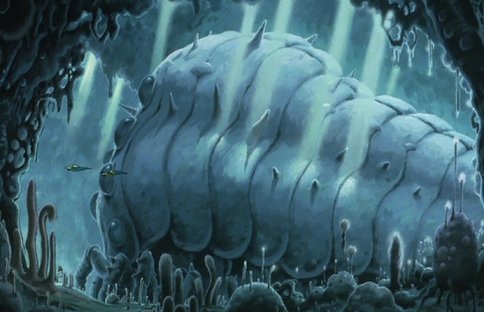
her. The scene in which we meet Nausicaä establishes her relationship with the outside
world. Carefully collecting spores from a plant, she happens upon the deserted
shell of an Ohmu. Its crystalline form towers above her, and she approaches it
with something like reverence. Covered in eyes and tentacles, Ohmu are slightly
repulsive even as their intelligence and vastness grant them a kind of majesty.
As the Ohmu exemplify, although insects are nature’s representatives in Nausicaä, it is humans who are insect-like
in this film. We are tiny creatures approaching much larger life forms; the
appropriate response can only be awe.
Despite the worshipful portrait of nature, Miyazaki is a
fundamentally humanistic director, and in this film filled with numerous characters
and dense plotting, it’s Miyazaki’s empathy that holds Nausicaä together. There’s no true
villain in Nausicaä, and even dastardly
characters like the Tolmekian ruler Kushana still emerge sympathetic. Although Kushana
lies, murders, and cheats, she acts to save the human race from extinction, no
matter how misguided or unethical her methods might be. Likewise, the violence other
characters perpetrate on their fellow human beings and on the natural world stems
not from any inherent malice but from the desire to protect their homes and
families. Humanity, in Miyazaki’s portrayal, is essentially good but is divided
hopelessly into warring factions that dangerously exploit the same earth they
should be caring for. Humanity at its worst is symbolized by the Warrior
Giants, themselves symbols of nuclear weaponry. Soulless monsters that do nothing but destroy,
the Giants lie at the root of mankind’s original quarrel with nature, and at
the film’s end, Miyazaki suggests that only by abandoning such technology can
humankind move forward, both toward unity with itself and with the earth.

Cool. I really liked the manga.
ReplyDelete